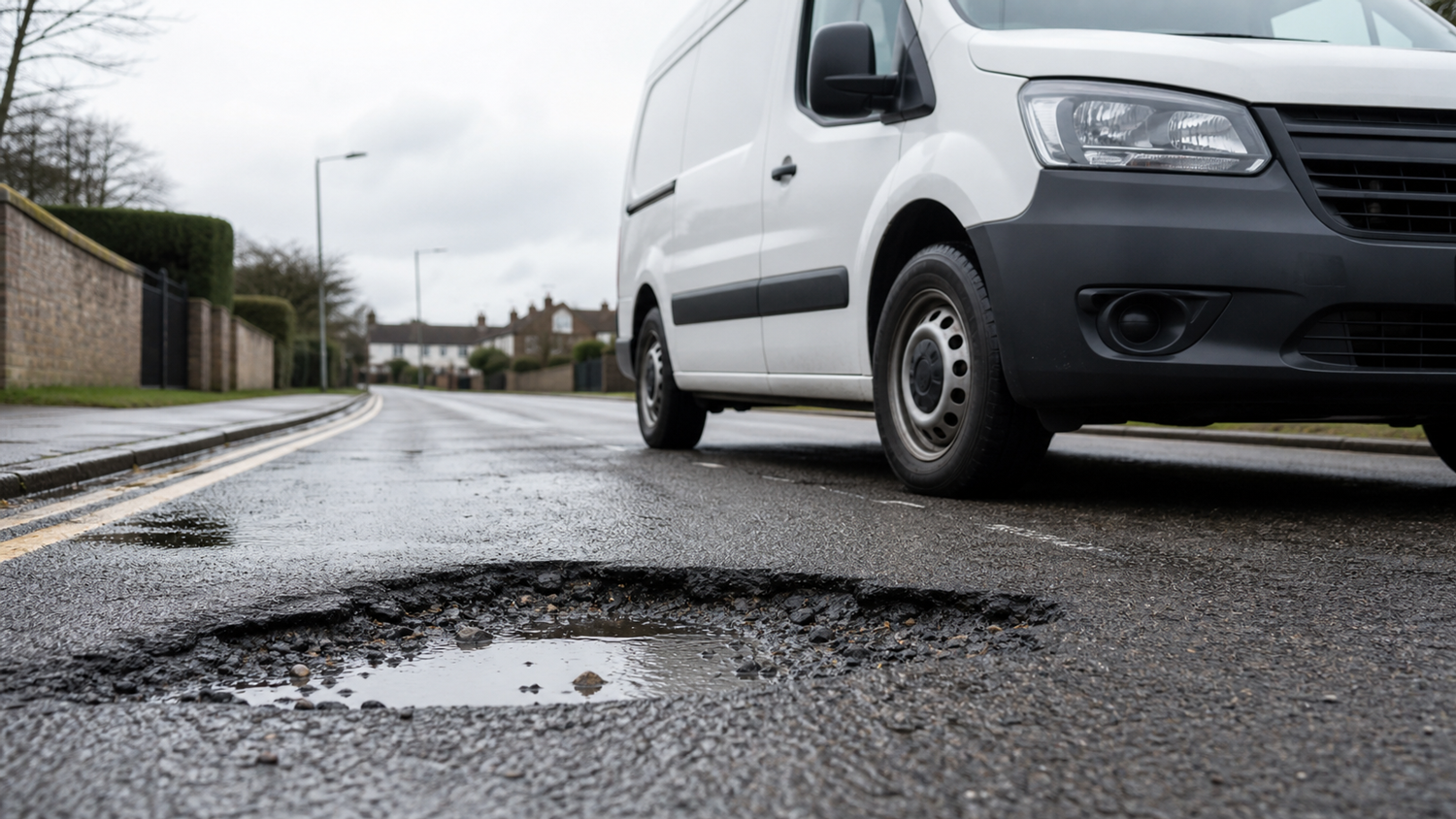
Every driver knows the feeling. You are concentrating on the road, perhaps travelling to a job, collecting materials or visiting a customer, when a pothole appears too late to avoid. There is the thud, the wince, and then the worry: has it damaged the tyre, cracked the alloy, knocked out the tracking or done something worse underneath?
For many of our customers, potholes are not just an irritation. They are a direct business cost.
When a vehicle is part of your working day, damage from poor road surfaces is not limited to a repair invoice. It can mean a missed appointment, a delayed engineer, a van off the road, an urgent tyre replacement, a rearranged route, or a job that takes longer than planned. Those small disruptions add up quickly, especially for businesses already managing rising fuel, insurance, labour and parts costs.
That is why the government’s latest announcement on pothole repairs matters. On 9 June 2026, the Department for Transport announced tougher guidance for councils in England, requiring them to publish clearer reports on how well they are maintaining local roads and what they are doing to prevent repeat repairs. The government says councils will be expected to move away from short-term patching and towards longer-term preventative maintenance, with red, amber and green ratings used to show progress. The announcement is backed by a stated £7.3 billion in long-term local road funding.
The key point is simple: filling the same hole again and again is not good enough. It wastes public money, frustrates drivers and leaves road users paying the price.
The repair bill lands with drivers first
The financial impact is already significant. The GOV.UK announcement states that pothole-related damage costs an average of £500. RAC garage data puts the cost of repairs for anything more serious than a puncture at up to £590 for a typical family car. TyreSafe, using AA Pothole Index data, reported that the AA attended 613,638 pothole-related breakdowns in 2025, covering damage to tyres, wheels, steering and suspension. TyreSafe estimated the financial impact of potholes on vehicles at £589 million in 2025, up from £579 million in 2024 and £474 million in 2023.
Those figures are not abstract. They show up as a driver paying for a tyre they were not expecting to replace, a business losing a vehicle for half a day, or a fleet manager trying to keep jobs moving while another van is waiting for inspection.
The obvious damage is only part of the problem. A pothole strike can weaken a tyre, bend a wheel, affect steering geometry or damage suspension components. Sometimes the vehicle appears fine at first, but the consequences emerge later as uneven tyre wear, vibration, MOT failures or premature replacement costs.
That hidden damage is particularly painful for working vehicles. A van or car may still be driveable after the impact, but if the tyre has been compromised or the suspension is out of line, it can become less safe and more expensive to run. None of that helps a business serve customers well.
Downtime is expensive too
For our customers, the vehicle is often the link between the office, the job site and the customer. If it is unexpectedly off the road, the cost is broader than the repair itself.
A tradesperson who loses a morning to a damaged wheel is not just paying for the wheel. They may also be losing billable time. A service company with multiple field workers may need to reassign jobs, change schedules, contact customers and absorb the admin cost.
This is where potholes become a productivity issue. A poor road surface turns into wasted time, more phone calls, more rescheduling and less certainty for everyone involved. When margins are tight, even one avoidable repair can make a difference.
Compensation is not a reliable safety net either. RAC analysis found that pothole compensation claims submitted to 18 local authorities with some of Britain’s longest road networks more than doubled between 2022 and 2023, rising from 8,327 to 20,432. But only 15% of those claims were paid out by 17 councils, with an average payment of about £260. That is well below the potential cost of more serious repairs.
Even when a driver can prove damage, getting money back is far from guaranteed.
Patching is not the same as fixing
The frustration for drivers is that the same potholes often seem to come back. A quick patch may make a road passable for a while, but if the underlying surface is failing, water gets back in, traffic keeps pounding the same area and the hole opens up again.
The Asphalt Industry Alliance’s ALARM 2026 survey shows the scale of the maintenance challenge. Local authorities in England and Wales face a record £18.62 billion backlog of carriageway repairs, and the AIA estimates it would take 12 years to clear. Around half of the local road network is reported to be in good structural condition, while almost one in six local roads has less than five years’ structural life remaining.
That matters because prevention is usually cheaper and less disruptive than repeated emergency repair. Better drainage, surface dressing, resurfacing roads that have reached the end of their life, and making durable repairs all reduce repeat failures.
The government’s new reporting requirements should help by making councils more accountable for outcomes, not just activity. Counting how many potholes have been filled is useful, but drivers need to know whether repairs are lasting.
What drivers can do now
Longer-term road maintenance is essential, but customers still need to protect themselves today.
After hitting a pothole, it is worth checking the tyre as soon as it is safe. Look for bulges, cuts, cracks or a loss of pressure. If the steering wheel feels off-centre, the vehicle pulls to one side, there is vibration, or the impact was heavy, get the vehicle inspected. It is also sensible to photograph the pothole, location and damage, and to report the defect.
For businesses, it helps to make pothole incidents part of vehicle reporting. If drivers record impacts quickly, managers can arrange checks before minor damage becomes a larger bill. Keeping tyres correctly inflated, monitoring tread and acting on alignment issues can also reduce avoidable costs.
None of this removes the responsibility from those maintaining the roads. Customers should not have to budget for constant pothole damage as a normal part of motoring. But until the roads improve, quick reporting and regular checks can help reduce risk.
Potholes cost money because they interrupt the ordinary work of getting from one place to another. They damage vehicles, waste time, disrupt jobs and leave customers paying for problems they did not create. Better, longer-lasting road repairs are not just about smoother journeys. They are about protecting people’s time, keeping businesses moving and stopping avoidable costs from landing on drivers.